
Analysis & practice · 7 min
Choose a chord progression, then check it by ear
Build a four-chord idea in C major, bring its MIDI into your session, and use audio chord estimates to explore a reference recording.
Read the story
TUNENOODLE / Free · runs in your browser
Generate sine, square, triangle, sawtooth or white noise tones by note or frequency, sweep the audible range, hear them safely with fades and a -12 dBFS ceiling, and download a WAV.
In your browser · no upload
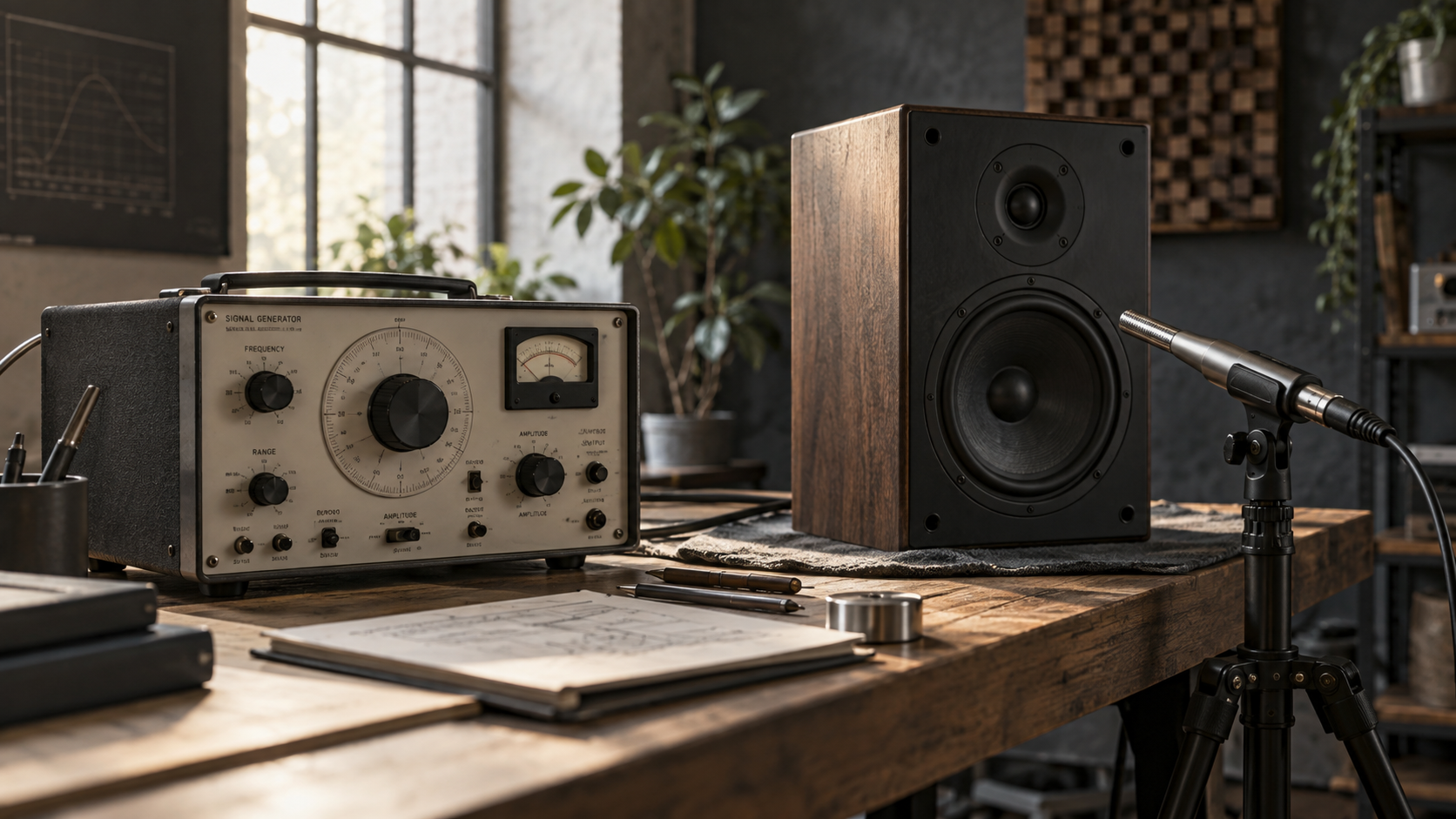
Create a known sound before you investigate an unfamiliar one. The tone generator produces a chosen note, a frequency in hertz, or a sweep you can listen to and save as WAV. Use a sine wave as a simple pitch reference, then compare richer waveforms to hear how harmonics change the timbre. A short sweep can support a controlled playback experiment, while white noise provides a broad signal for comparison. Everything is generated in your browser. Start with low device volume and a short duration: the digital level limit does not measure the sound pressure at your ears. This tool supplies test signals; it does not diagnose hearing or automatically calibrate a room.
The tone is synthesized in your browser and exported as a 16-bit WAV. No upload, account or credits are involved.
| Parameter / option | What it changes |
|---|---|
| Pitch and waveform | Choose a note and octave or 20–20,000 Hz, then select sine, square, triangle, sawtooth, or white noise. |
| Duration and level | Set 0.1–60 seconds and a level up to −12 dBFS. Short fades soften the beginning and end. |
| Frequency sweep | Set start/end frequencies and a linear or logarithmic curve. A periodic waveform is needed to hear a changing pitch. |
Lower your device volume, choose a sine wave, and set a note or frequency.
Choose a short duration and low level; enable and configure a sweep if needed.
Generate, preview briefly, and download the WAV once the signal matches your experiment.
Their harmonics differ. A sine wave is the simplest reference; square and sawtooth waves contain more upper-frequency energy.
Analysis & practice · 7 min
Build a four-chord idea in C major, bring its MIDI into your session, and use audio chord estimates to explore a reference recording.
Read the storyTUNENOODLE
In your browser · no upload